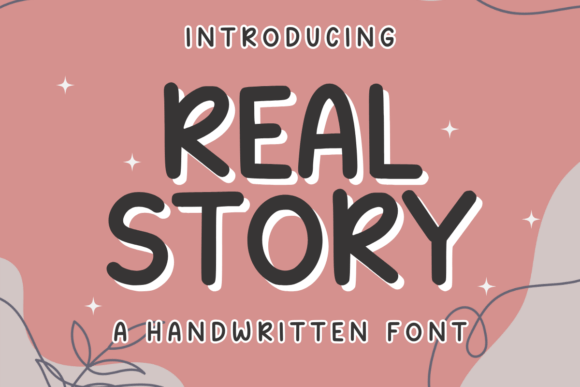
Real Story: A Handwritten Font That Feels Like Your Brand’s True Voice
Last Tuesday, I was helping a local candle maker finalize her new soy wax jar labels—simple kraft paper wraps with minimal ink, meant to feel warm and human. She’d been using a free script font for months, but something felt off: the letters looked stiff, overly symmetrical, like they’d been traced instead of written. Customers loved her scents, but her packaging didn’t quite reflect the care she poured into every pour. That’s when we swapped in Real Story. Within minutes, the label softened. The “Lavender & Oat Milk” title suddenly looked like it belonged on a hand-poured candle—not a stock template. That’s the quiet power of a truly thoughtful handwritten font.
What Makes Real Story Feel So… Real?
Real Story isn’t just another script font—it’s a premium handwritten typeface with natural rhythm, subtle variation, and gentle imperfections that echo real pen-on-paper movement. The lowercase “a” has a soft, open bowl; the “g” curves with relaxed confidence; the connecting strokes breathe rather than lock up. It’s sweet without being cutesy, friendly without feeling generic, and polished without losing its handmade charm. As a Script Amp font, it’s designed for impact—not subtlety—and works best where personality matters most: logos, product names, short headlines, and signature moments in your brand storytelling.
Where It Shines (and Where to Use It Wisely)
We tested Real Story across six real business touchpoints—and each time, it elevated consistency without demanding design expertise:
- Product labels & packaging: On a small skincare serum bottle, Real Story’s clean letterforms stayed legible even at 8pt size—especially with its well-spaced characters and open counters. Just avoid ultra-thin weights for tiny print; stick to the regular or bold weight for clarity.
- Café menus & chalkboard graphics: Paired with a light sans serif (like Poppins Light) for body text, Real Story became the perfect “hero name” for seasonal lattes or daily specials—inviting but never distracting.
- Thank-you cards & stickers: Its natural flow made handwritten-style notes feel intentional, not rushed. One boutique owner told me her customers now photograph their thank-you cards and tag her—proof that typography can spark organic sharing.
- Instagram templates & digital ads: On mobile screens, Real Story holds up beautifully in banners and story highlights—its moderate contrast and generous x-height keep it readable even at smaller sizes.
- Online shop banners & Etsy listings: Used as a display font over lifestyle photos, it added warmth without competing with the product. Think “Small Batch • Hand-Poured • Made in Portland”—short, sincere, and unmistakably human.
That said, Real Story is a display font, not a workhorse. It’s not built for paragraphs, long ingredient lists, or fine-print disclaimers. Save it for moments that need heart—not homework.
Pairing It Right (Without Overthinking)
You don’t need a design degree to pair Real Story well. In fact, its strength lies in how easily it plays with others. Here’s what worked consistently across client projects:
- With a clean sans serif: Try Inter, Lato, or Montserrat for body text, pricing, or contact info. The contrast feels modern and grounded—like a handwritten note on crisp stationery.
- With an elegant serif: For wedding stationery or luxury beauty brands, a refined serif like Playfair Display adds quiet sophistication while letting Real Story lead with warmth.
- On its own (sparingly): A single word in Real Story—“Yes,” “New,” “Handmade,” “Love”—can anchor a social graphic more powerfully than three lines of smaller text.
Avoid pairing it with other highly decorative scripts or condensed fonts—they’ll compete instead of complement. When in doubt, go simple. Real Story already brings the character.
Before You Install: Quick Practical Checks
Since you’ll likely use Real Story commercially—on printed labels, digital templates, or client work—take two minutes before downloading:
- Licensing: Confirm it includes commercial use rights for physical products (e.g., candles, soap, apparel) and digital resale (e.g., Canva templates, Shopify themes). Most Script Amp fonts do—but always double-check the license file.
- File formats: Look for OTF and TTF files. OTF supports OpenType features like ligatures and stylistic alternates, which add polish to words like “The” or “And.”
- Language support: If you serve bilingual customers or sell internationally, verify it includes extended Latin characters (á, ñ, ü, etc.). Real Story covers Western and Central European languages well.
- Weights & alternates: While it’s primarily a single-weight script font, check if it includes bonus swashes or alternate characters—they’re perfect for logos or special-edition packaging.
Typography isn’t about perfection—it’s about resonance. When your customer sees your brand name set in Real Story, they don’t just read it. They feel the intention behind it: the care in your craft, the honesty in your voice, the humanity in your hustle. That’s why, whether you’re updating a café menu, designing your first candle label, or building a cohesive Instagram feed, choosing a font like Real Story isn’t a detail—it’s your first quiet handshake with every person who chooses you.